Some links on this page are affiliate links. If you buy through them we may earn a commission at no extra cost to you. This guide draws on Gordon, Grimmer-Somers and Trott’s home trial of five pillow types in 106 side sleepers (Journal of Pain Research, 2010), Holdaway and colleagues’ study of sleep position and shoulder pain in 761 workers (BMC Musculoskeletal Disorders, 2018), Pang, Tsang and Fu’s 2021 review of pillow design in Clinical Biomechanics, the Sleep Foundation’s side-sleeper pillow and shoulder-pain guides (medically reviewed, updated October 2026), physical therapist Jen Lesko’s pillow advice for Therapeutic Associates, Hinge Health’s physical-therapist-reviewed shoulder sleep guide, and Mayo Clinic’s shoulder pain guidance. The mattress example is our own, from more than two years on a medium-firm foam bed. This is sleep-setup advice, not medical advice.
Start with which shoulder hurts. If it is the one you slept on, the ache has a plausible mechanical story, and it is usually one of two. Something under your head was too short, so your bottom shoulder spent the night holding up your upper body. Or something under the shoulder pushed back too hard. Bedding can make either one worse, and both are cheaper to test than they look.
Test the pillow first. Loft, the height a pillow holds under your head, is the setting that most directly changes how much load the bottom shoulder takes, and an adjustable pillow lets you try several lofts in a week for the price of one pillow. If the loft is right and the bottom shoulder still aches, look at the mattress, which can be too firm at the shoulder for a side sleeper, and test that with a topper before you price a new bed. If the pain is sharp, getting worse, or there when you are not lying on it, skip the shopping and see a clinician.
What the Studies Do and Do Not Show
The internet is more confident about this than the research is. The largest study we found, Holdaway and colleagues’ 2018 look at 761 workers, found no clear link between the position people slept in and shoulder pain or rotator cuff tendinopathy, and the authors allowed that sleep position may not play a meaningful role at all. They also listed what they did not measure, and pillows and mattress firmness were on that list. That gap is where this guide lives.
The pillow evidence is narrower and more useful. Gordon, Grimmer-Somers and Trott sent 106 side sleepers home with five pillow types, a week on each, and compared them with each person’s own pillow. On their own pillows, 17.9 percent woke with shoulder-blade or arm pain at least once. Feather was the worst performer, with 2.6 times the odds of that pain compared with the sleepers’ own pillows, and latex was the most consistent across every symptom the trial tracked. Pang, Tsang and Fu’s 2021 review of 35 pillow studies adds the part that matters most here: lying on your side, the shape and height of the pillow may change how your neck lines up, where the fill material may not.
None of that says your pillow caused your shoulder problem, and we are not going to pretend it does. Hinge Health’s physical therapists put it plainly: a mattress or sleeping position can contribute to shoulder pain, but it is usually not the primary cause. What bedding decides is how much load a sore shoulder carries for most of a night. That part is worth getting right.
Who This Is For
Three readers, mostly. The side sleeper whose bottom shoulder aches on waking and is back again every morning. The person who changed mattresses or added a topper and started waking sore soon after, which can be a pillow problem in disguise. And the broad-shouldered sleeper still on the flat pillow that came with the apartment, folded in half. If your pain wakes you no matter how you lie, started with a fall or an injury, or comes with swelling, read the last section first.
Why the Pillow Comes First
On your side, the gap between the mattress and your head is roughly the width of your shoulder, minus however far that shoulder sinks into the bed. The pillow’s job is to fill that gap so your head stays level with your spine. Too short and the head drops toward the mattress; Jen Lesko, a physical therapist at Therapeutic Associates, describes what happens next this way: “the shoulder winds up with the pressure of holding all your body weight.” Too tall and the head tips the other way, and the neck takes the strain instead.
The Sleep Foundation’s side-sleeper pillow guide, medically reviewed by physical therapist Jenny Iyo and updated October 20, 2026, puts most side sleepers on a pillow at least 4 inches thick and says broad shoulders may need more than 6. Then it adds the caveat that drives the rest of this page: if you sink deeply into your mattress, even 4 inches can be too high. Pillow and mattress are one system. Fix the pillow first because it is the cheap half, the half you can change in minutes, and once it is right, whatever ache is left is the mattress talking.
Measure Your Loft With Towels
Ignore the number on the box for a minute. A listed loft describes the pillow sitting untouched; what matters is the height left under your head once it compresses, on your mattress, in your position. A few folded bath towels and a second person (or a propped-up phone) will get you that number tonight.
- Lie on your own bed, on the side you usually sleep on, with no pillow. Bring the bottom arm forward instead of tucking it under your head.
- Have your helper stand at the foot of the bed, or prop a phone there and record, and look at the line from the middle of your back up through your neck. With no pillow, your head will tip down toward the mattress.
- Slide folded towels under your head one at a time until that line runs straight. Lesko’s alignment check works lying down: ears in line with your shoulders, chin in line with your sternum.
- With your head still on the stack, have your helper measure from the mattress to the top of the towels. That is your working loft.
- Lie on your current pillow and measure it the same way, head on. If the two numbers disagree, you have found the first thing to change.
Do it on the bed you sleep on, because a firm guest bed and a soft main bed will give you different numbers (the Sleep Foundation’s sinkage caveat, in practice). Then redo it whenever something under you changes: a new mattress, a topper, or a pillow that has quietly flattened. The owner reports behind our Coop Eden review put that pillow’s loft loss at 10 to 20 percent by month 12, so a pillow that measured right last fall may not now. Our pillow-by-sleep-position guide covers the same fit question for back, stomach and combination sleepers.
Dial It In With an Adjustable Pillow
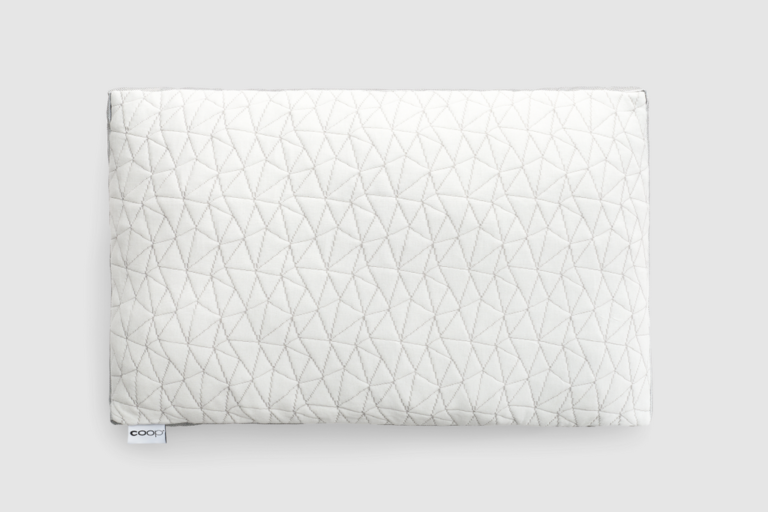
An adjustable pillow is the cheapest way to act on the towel number, because you are buying a range of lofts instead of one. The Coop Eden is the first pick in our side sleeper pillow roundup. It is shredded memory foam and microfiber under a washable cover, it ships overstuffed, and Coop includes an extra half pound of fill in a separate bag so you can put back what you take out. Start full, pull fill out a handful at a time until it matches your towel stack, and give each change a couple of nights before you judge it. It was $87.20 on Amazon when we last read the listing (November 10, 2026).
If your pillow is warm by morning, the Eden Cool+ is the same idea with a cool-touch cover, a firmer side and a softer side; our Coop Eden vs Eden Cool+ comparison covers when that is worth the difference.
The Layla Kapok is the other adjustable pillow side sleepers cross-shop, and our read on it is researched from Tom’s Guide’s August 2025 review. It blends shredded memory foam with kapok fiber, and the fill comes out into an included storage bag. Tom’s Guide’s tester found it medium-firm to firm out of the box, removed about a quarter of the fill, and reported that once adjusted the loft filled the gap between ear and shoulder. Plan on taking fill out before you judge it. It was $114 when we last read its listing; our Layla Kapok review has the longer take, and Coop Eden vs Layla Kapok puts the two side by side.
If you would rather not adjust anything, fill type is the next lever. In the Gordon trial, latex held up best for side sleepers and feather worst. The cooling pick in our side sleeper roundup is a shredded latex pillow, and nothing on that list is feather.
When the Mattress Is the Problem
The tell is this: the pillow matches your towel number, you have given it a week or two, and the bottom shoulder still aches in the morning. Now the surface under the shoulder is the likeliest suspect, and for a side sleeper the more common fault is a bed that is too firm there.
The Sleep Foundation’s shoulder-pain mattress guide (medically reviewed by Lulu Guo, MD, a board-certified sleep medicine physician, updated October 19, 2026) recommends a 5 to 7 on a 10-point firmness scale for shoulder pain, with side sleepers leaning toward the softer end and people over 230 pounds toward the firmer end. Dr. Guo’s summary of the two failure modes is the clearest we have read: too firm “increases pressure on the shoulder,” and too soft “lacks the support needed to maintain alignment.”
We sit right on that 230-pound line, at 6 ft 2, and spend about 70 percent of the night on our side. Our old bed was a $150 spring mattress. We replaced it with the medium-firm foam Nectar, and the morning shoulder stiffness that came with the old bed was gone within the first week; the foam takes the shoulder and hip while the support layer underneath keeps the spine from bowing. That is one sleeper’s data point, and a cheap spring mattress is a low bar to clear. It is also the clearest version of the mattress-side problem we can show you.
Before you price a new mattress, run the cheap test. Strip the bed and look for body impressions where you sleep; our topper versus new mattress guide walks through the check, and if there is a valley, a topper will follow it down. If the surface is sound but hard, a 3-inch memory foam topper gives the shoulder somewhere to go, and the Sleep Foundation’s guide makes the same point: a topper can add softness without sacrificing support. The Linenspa 3-inch is the one we own and the side-sleeper pick in our toppers under $100 roundup, at $89.99 when we last read it. Two cautions from our Linenspa review: the gel is cool for the first 15 to 30 minutes and then sits at body temperature, so it is a comfort buy rather than a cooling one, and owner reports have the budget foam softening noticeably somewhere between month 18 and month 24.
Check the Linenspa 3-inch topper on Amazon
One more step, and it is the easy one to skip. A topper lets the shoulder sink, which shrinks the gap the pillow has to fill. Run the towel test again the week the topper goes on. The pillow that was right on the firm bed may now be too tall, and a too-tall pillow on a softer surface can turn a shoulder fix into a neck problem.
The opposite fault exists too. If the bed is old and soft enough that your shoulder and hips sink into a trough, that is Dr. Guo’s second failure mode, and a topper makes it worse. That one is a replacement, and the topper versus new mattress guide has the checks.
What We Would Do Starting Tonight
Measure with towels tonight. Set the pillow to that number this week, with a Coop Eden or a Layla Kapok if you need a new one, and sleep on the side that does not hurt. Give it two weeks. If the bottom shoulder still aches and the mattress has no valley, put a 3-inch topper on it and measure again, because the number will have moved. Only then price a new mattress, toward the softer end of the Sleep Foundation’s 5 to 7 range for most side sleepers and the firmer end above 230 pounds. And if any of the warning signs in the last section show up along the way, skip the rest and see someone.
How to Lie While You Sort It Out
Position matters while you work through the bedding, and the Sleep Foundation’s shoulder-pain pillow guide (also reviewed by Jenny Iyo, DPT) and Hinge Health’s physical therapists agree on the basics. Sleep on the side that does not hurt. Hug a pillow in front of you so the top arm has somewhere to rest, and put another between your knees. If neither side is comfortable for a while, the Sleep Foundation calls lying on your back with a pillow under the sore arm often the best position. Stomach sleeping is the one position the same guide does not recommend for shoulder pain.
When to Stop Adjusting and See Someone
Bedding can take load off a shoulder. It cannot tell you what is wrong with one, and we will not guess. Mayo Clinic’s guidance is the line we would use. Shoulder pain that comes with trouble breathing, chest tightness or sweating can signal a heart attack: call 911. After a fall or other accident, a shoulder that looks deformed, an arm you cannot move away from your body, intense pain or sudden swelling means urgent care or the emergency room. Swelling, redness, warmth around the joint, pain that keeps getting worse, or a shoulder that is getting harder to move are reasons to book an appointment.
Short of those, our rule is simple. If the right loft and a couple of weeks of the positions above have not changed the morning ache, stop shopping. Hinge Health’s physical therapists list overuse, bursitis, rotator cuff problems, frozen shoulder and osteoarthritis among the common causes of night shoulder pain, and no pillow fixes any of them. A physical therapist or your doctor can tell you which one you are dealing with, which is more than a bedding page can.
Frequently asked questions
Why does my shoulder hurt when I sleep on my side?
Often because of how much load the bottom shoulder takes. A pillow that is too short lets the head drop and leaves the shoulder holding up the upper body, and a mattress that is too firm pushes back at the shoulder instead of letting it sink. Bedding is usually not the root cause of a shoulder condition, though. Overuse, bursitis, rotator cuff problems, frozen shoulder and osteoarthritis are common causes, and pain that persists or worsens needs a doctor or physical therapist.
What pillow loft does a side sleeper with shoulder pain need?
The Sleep Foundation puts most side sleepers on a pillow at least 4 inches thick and broad-shouldered sleepers at more than 6, but a soft mattress lowers the number. To find yours, lie on your own bed without a pillow, stack folded towels under your head until your ears line up with your shoulders and your chin with your sternum, and measure the stack with your head still on it.
Can a mattress that is too firm cause shoulder pain?
It can make it worse. The Sleep Foundation's shoulder-pain guidance is a 5 to 7 on a 10-point firmness scale, with side sleepers toward the softer end and people over 230 pounds toward the firmer end. Too firm puts more pressure on the shoulder; too soft lets it sink out of alignment. Check the pillow loft first, since the two interact.
Should I sleep on my painful shoulder?
Not while it is sore. The Sleep Foundation and Hinge Health's physical therapists both suggest sleeping on the other side and hugging a pillow so the top arm is supported, or lying on your back with a pillow under the sore arm. Stomach sleeping is not recommended for shoulder pain.
Will a mattress topper help shoulder pain from side sleeping?
If the mattress is too firm and has no body impressions, a 3-inch memory foam topper gives the shoulder room to sink, and it is a cheap test before a new mattress. It will not fix a sagging bed. After adding one, measure your pillow loft again, because sinking deeper shrinks the gap the pillow has to fill.