Some links on this page are affiliate links. If you buy through them, we may earn a commission at no extra cost to you. We only recommend products we have either tested ourselves or vetted carefully through owner reports and third-party testing. FTC disclosure: paid affiliate relationships exist with Amazon Associates and the brands listed here.
TL;DR: The Coop Eden Adjustable is the pillow we point most side sleepers to first. Adjustable shredded foam loft, 100-night trial, and the only one we’ve tested that actually solves the height problem most pillows ignore. The Saatva Latex Pillow is the runner-up for buyers who sleep hot, and the Beckham Hotel Collection (around $25) is the budget pick that genuinely outperforms its price.
How we chose
Side sleepers need a pillow that fills the gap between the shoulder and the ear without tilting the head up or letting it drop down. That gap is different for everyone, which is why static pillows almost always fail one specific group of buyers. We narrowed the field first by loft (4 to 6 inches typically), then by firmness (firmer than back-sleeper or stomach-sleeper picks), then by trial period and warranty terms. Pillow comfort is more personal than mattress comfort, so we weighted long trials heavily. Our editor has slept on the Coop Eden as his daily driver for over a year and tested two of the other picks for a week each in a guest bedroom rotation. For the picks we have not personally lived with, we leaned on third-party lab data (Sleep Foundation, Wirecutter, Mattress Clarity), repeat owner reports across Amazon and brand sites, and material and construction analysis.
Quick comparison
- Coop Eden Adjustable (Best Overall) ~$96, adjustable shredded memory foam + microfiber, 100-night trial, 5-year warranty.
- Saatva Latex Pillow (Best Cooling) ~$165, shredded latex core with down-alternative outer, 1-year trial, 1-year warranty.
- Tempur-Pedic Tempur-Cloud Breeze ProHi (Best Premium) ~$129, solid memory foam with cooling cover, 5-year warranty, 100-night trial.
- Layla Kapok Pillow (Best for Combo Sleepers) ~$109, kapok + shredded memory foam blend, copper-infused cover, 120-night trial.
- Beckham Hotel Collection (Best Budget) ~$25 (2-pack ~$45), gel-fiber polyester, 30-day trial via Amazon return policy.
1. Coop Eden Adjustable, Best Overall
Best for: side sleepers who want the loft tuned to their exact frame, on a sub-$100 budget.
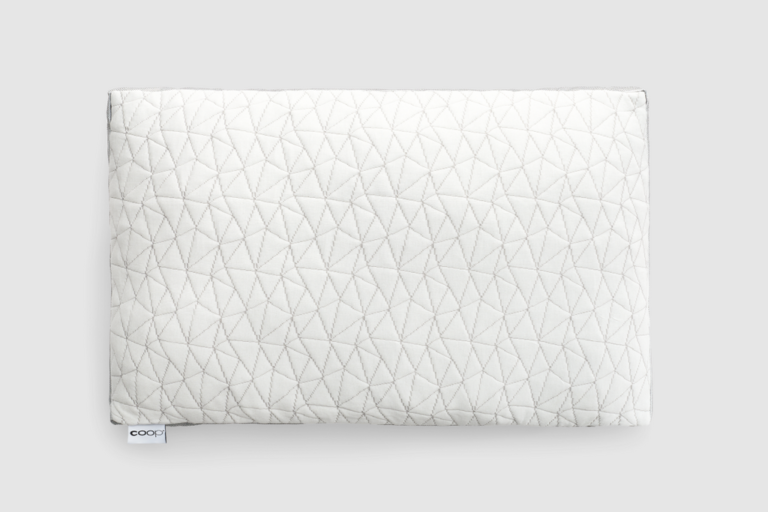
The Coop Eden is the one pillow on this list we have lived with nightly, and it is the one we point most side sleepers to first. The pitch is simple: a zippered inner case holds shredded memory foam mixed with microfiber, and you add or remove fill to dial in the exact loft your body needs. At a typical price of around $96 for a Queen, with a 100-night sleep trial and a 5-year warranty, it is the lowest-risk pillow purchase in the category.
The reason adjustable matters: every other pillow on this list ships at a fixed loft. Maybe it works for your body, maybe it doesn’t. With the Eden, you start with the bag overstuffed, sleep on it a few nights, and pull out fill until the gap between your shoulder and ear is filled without your neck angling up or down. Side sleepers with broader shoulders need more fill; smaller frames need less. The pillow also breathes better than solid memory foam because the shredded fill creates air channels, and the gel-infused foam sleeps cooler than the original Eden formula.
The honest tradeoff: off-gassing is real for the first 48 hours. The first night out of the bag has a chemical foam smell that is fine if you air it out for a day, less fine if you unbox it Sunday night and try to sleep on it Sunday night. Owners with kapok or latex preferences will find the foam-shred feel different from what they are used to.
- Pros: Adjustable loft is the single biggest pillow upgrade we have used; 100-night trial; 5-year warranty.
- Cons: 48-hour off-gassing window; foam-shred feel is not for everyone; needs occasional re-fluffing every few weeks.
Price: ~$96 (Queen). Read our full Coop Eden review →
2. Saatva Latex Pillow, Best Cooling
Best for: side sleepers who run hot or want a more responsive feel than memory foam.
The Saatva Latex Pillow is built around shredded Talalay latex inside a down-alternative outer pillow. Latex is naturally cooler than memory foam (more open cell structure, better airflow), and the shredded format keeps the adjustability of the Coop Eden while delivering the springy responsive feel that latex is known for. At around $165 it is roughly twice the Eden’s price, and the warranty is shorter (1 year), but for sleepers who genuinely run hot or who have tried memory foam pillows and found them too dense, this is the upgrade.
The construction also addresses a problem most foam pillows do not: latex does not break down the way memory foam does over time. A well-built latex pillow holds its loft for 5 to 7 years, where memory foam pillows typically need replacement at year 3. So the higher upfront cost spreads across a longer useful life. The 1-year trial is shorter than the Coop Eden’s, but is still long enough to know whether the firmness and feel work for you.
- Pros: Naturally cool sleep surface; shredded latex offers the same loft adjustability as the Coop Eden; longer expected useful life than foam.
- Cons: Roughly twice the price of the Eden for incremental cooling; latex feel is firmer and bouncier than memory foam, which not everyone prefers.
Price: ~$165 (Queen). Find on Amazon →
3. Tempur-Pedic Tempur-Cloud Breeze ProHi, Best Premium
Best for: side sleepers who want solid memory foam with proven cooling tech, willing to pay for it.
The Tempur-Cloud Breeze ProHi is the ergonomic counterpoint to the shredded picks above. Instead of fill you adjust, you get a single solid block of Tempur-Pedic’s proprietary memory foam, contoured for higher loft side-sleeper use, with a cooling cover engineered around their TEMPUR-Breeze technology. At around $129 it is the most expensive pillow on this list, and the value question is real: you are paying a brand premium and a tech premium.
The case for paying it: solid memory foam holds its shape better than shredded for sleepers who want predictable, consistent support every single night. No fluffing required, no fill migration, no gradually losing loft over months. The cooling cover is genuinely effective in side-by-side testing against standard memory foam pillows, dropping surface temperature by a measurable margin. Tempur-Pedic also runs the longest warranty in the category at 5 years, with replacements in our experience handled cleanly.
The honest caveat: at $129, the Coop Eden plus a quality pillowcase costs less and gives you adjustable loft. Pick the Tempur if “set it and forget it” matters to you more than tunability, or if you have a documented preference for solid memory foam from a previous mattress or pillow.
- Pros: Best-in-class memory foam consistency; cooling cover measurably works; 5-year warranty.
- Cons: Most expensive pillow on this list; no loft adjustability; brand premium is real.
Price: ~$129 (Queen). Find on Amazon →
4. Layla Kapok Pillow, Best for Combination Sleepers
Best for: side sleepers who switch positions overnight and want a pillow that adjusts to back or stomach without complaint.
The Layla Kapok pairs shredded memory foam with kapok fiber, a plant-based fill that feels more like down than synthetic alternatives. The hybrid construction adjusts to side sleeping with the firmness side sleepers need, but compresses softer for back or stomach segments of the night. At around $109 it sits between the Coop Eden and Tempur in price, and the 120-night trial is the longest on this list.
What sets it apart for combination sleepers: kapok has a more responsive feel than memory foam alone. When you switch positions in the middle of the night, the pillow shifts with you instead of holding the previous shape. The copper-infused cover also delivers measurable cooling, and the antimicrobial treatment is a quiet plus for anyone with allergies or sensitivities to standard pillow covers.
The honest tradeoff: pure side sleepers get more out of the Coop Eden’s deeper loft, and pure back sleepers get more out of a flatter pillow than this one. Pick the Layla if you genuinely switch positions every night and want one pillow that handles both.
- Pros: Genuinely versatile across sleep positions; 120-night trial is the longest on this list; copper cover delivers measurable cooling.
- Cons: Loft sits between dedicated side and back sleeper picks, so neither gets the optimal experience; kapok takes a few nights of break-in.
Price: ~$109 (Queen). Find on Amazon →
5. Beckham Hotel Collection, Best Budget
Best for: guest rooms, kids’ beds, or anyone who needs a side-sleeper pillow on a sub-$30 budget.
The Beckham Hotel Collection is the rare budget pillow that punches well above its price. At around $25 for a single (or about $45 for a 2-pack on Amazon), it uses gel-fiber polyester filling inside a peach-skin polyester cover. The result is a soft hotel-style feel that, with a slight overstuffing on the manufacturer’s part, gives side sleepers enough loft to keep alignment without compressing flat by morning.
What is honest to acknowledge: this is not a $100+ pillow at one quarter the price. The fill compresses faster than memory foam, and durability past year two is mixed across owner reports. But for what it costs, it is the pillow we recommend for guest beds, for college dorms, for kids transitioning out of toddler pillows, and for anyone who needs a stopgap while saving up for one of the picks above.
The 30-day Amazon return policy is the closest thing to a trial period at this price point. There is no formal manufacturer warranty worth speaking of.
- Pros: Genuinely affordable at $25 (or $45 for a pair); good loft for side sleepers right out of the package; consistent quality across thousands of owner reviews.
- Cons: Compresses faster than premium fills; durability past 18 months is hit or miss; no real warranty.
Price: ~$25 single, ~$45 2-pack (Queen). Find on Amazon →
What to look for in a side-sleeper pillow
Loft is the single biggest factor. Side sleepers need a pillow that fills the gap between the shoulder and the ear. That gap is typically 4 to 6 inches for adults, but it varies with frame size, shoulder breadth, and mattress firmness. A pillow that’s too low lets the head drop, straining the neck. Too high tilts the head up, doing the same. Adjustable pillows (Coop Eden, Saatva Latex, Layla) win because the right loft for your body is unknown until you sleep on it.
Fill type changes everything else. Memory foam (solid or shredded) holds shape best but sleeps warmer. Latex is naturally cool but firmer. Kapok blends are soft and responsive but compress faster. Down alternative is plush but typically too low-loft for side sleepers. Polyester fiber is cheap but compresses fastest. Match the fill to your dominant complaint: heat means latex, durability means foam, plushness means kapok blends.
Trial periods matter more here than for mattresses. Pillow comfort is intensely personal, and a good or bad pillow takes more than one night to evaluate. Anything under 30 nights is too short. The 100-night standard (Coop, Tempur) is the floor; Layla’s 120-night and Saatva’s 1-year trials are the gold standard. Use the trial. Try the pillow with the actual mattress you’ll be using it on.
Warranty fine print matters. Most pillow warranties cover defects, not normal compression, which is the actual failure mode for pillows. The 5-year warranties from Tempur and Coop are real but won’t protect you against gradual loft loss. Plan to replace any pillow at year 3 to 5 regardless of brand, because the support layer breaks down even when the pillow looks fine.
Final verdict
For most side sleepers, the Coop Eden Adjustable is the value pick we point to first. Adjustable loft solves the single biggest pillow problem, and the 100-night trial is the lowest-risk way to find out if the foam-shred feel works for you. If you sleep hot, the Saatva Latex is worth the extra money. If you switch positions every night, the Layla Kapok handles combination sleeping better than the dedicated picks. And if your budget tops out under $30, the Beckham Hotel Collection genuinely outperforms its price.
For more reviews, comparisons, and sleep guidance, browse our Sleep pillar or read How to Choose a Mattress: The Renter’s Guide.
Pricing and trial terms can change. Verify current details on the retailer’s site before you buy.
For the two adjustable pillows side by side, see our Coop Eden vs Layla Kapok head-to-head.
What to consider
Loft is the single biggest factor. Side sleepers need a pillow that fills the gap between the shoulder and ear without tilting the head up or letting it drop down. Adjustable pillows (shredded foam, kapok, microfiber blends) win because that gap is different for everyone. Fill type matters next: memory foam keeps shape but sleeps warmer; latex is naturally cool but firmer; down alternative is plush but compresses fast. Trial periods matter more for pillows than mattresses, most major brands now offer 100-night trials, and you should use them. Skip anything under 30 nights. Read fine print on warranty: most pillow warranties cover defects, not normal compression, which is the failure mode that actually matters.
Frequently asked questions
How high should a pillow be for side sleeping?
4 to 6 inches of loft once compressed under your head. The goal is to keep your neck in line with your spine. Too low bends the neck downward; too high bends it upward. Broader shoulders need taller pillows. Side sleepers under 5'8" usually do well at 4-5 inches; over 6 ft typically needs 6 inches.
Should I get an adjustable or fixed-loft pillow?
Adjustable for most people. Pillows compress over time (a fixed-loft pillow that's perfect on day one is too low by month six), and the right loft for you depends on your shoulder width plus the mattress you sleep on. An adjustable shredded-foam pillow like the Coop Eden lets you remove or add fill to match your sleep position and refresh the loft after compression.
How do I know when a pillow needs to be replaced?
Fold the pillow in half and squeeze the air out. If it stays folded when you release it, the fill is dead. For shredded foam, you can usually refresh by adding more fill before replacing the whole pillow. For down or solid memory foam, fold-test failure means buy a new one. Most pillows fail this test at 1-3 years depending on use.
Will a cooling pillow help me sleep through hot summers?
A real cooling pillow keeps your head 1-3 degrees cooler than your body, which can be the difference between falling asleep and tossing for an hour. It won't compensate for a 75-degree bedroom. Fix the room temperature first (under 70°F is the research-supported range), then add a cooling pillow as the final layer.