Nectar Memory Foam Mattress Review (2026)
Two years on the Nectar Original and it's still the strongest sub-$1,000 memory foam mattress I'd point a side or back sleeper to. Runs warmer in a hot bedroom, edges are softer than a hybrid, but the 365-night trial and lifetime warranty make it a low-risk upgrade.

Pros
- Soft pressure relief
- Easy setup
- 365-night trial
- Lifetime warranty
- Best-in-class value sub-$1k
Cons
- Sleeps warm if you run hot
- Minimal edge support
- Off-gassing first 48 hours
- Not ideal for stomach sleepers
Some links on this page are affiliate links. If you buy through them, we may earn a commission at no extra cost to you. We only recommend products we’ve actually tested.
I bought the Nectar 12-inch Memory Foam mattress because I was sleeping on a $150 spring mattress that was actively making a recovery from a pulmonary embolism harder. More than two years of nightly use later, I have enough lived experience to say something useful, and well past the 30-day mark most online reviews stop at. This review is what I’ve found, what I’d flag, and who I think should and shouldn’t buy it.
Short version: at $699 as of my August 16, 2026 price check, with a 365-night trial and a lifetime warranty, the Nectar Original is the strongest sub-$1,000 memory foam mattress I’d point a side or back sleeper to. It runs warmer than a hybrid for some people, the edges are softer than a coil mattress, and stomach sleepers should look elsewhere. For most people upgrading from a worn-out or budget mattress, it’s a meaningful step up, and the year-long trial means you can find out for yourself with very little risk.
My take
This is the first quality mattress I’ve owned. The context matters: I was coming off a cheap spring mattress, dealing with chronic neck and back stiffness from Upper Crossed Syndrome, and managing a pulmonary embolism recovery where sleep quality wasn’t optional. The bar a new mattress had to clear was not subtle.
It cleared the bar quickly. Within the first couple of nights, the morning neck pain and back stiffness that had been a daily fact of life started easing. My Apple Watch sleep data went from broken three-hour stretches to consistent eight-plus hour nights with deep sleep numbers I’d never logged before. I won’t claim the mattress alone is responsible for that. Sleep is multifactorial, and a desperate baseline makes any upgrade look heroic. But the timing was hard to ignore, and two years in, I still notice the difference every morning.
That’s the honest frame for everything that follows. I’m not a lab. I’m an owner reporting what I’ve actually experienced, with the limits of that experience flagged where they matter.
Comfort & feel
The Nectar is medium-firm. Lying down on your back, the foam takes most of a minute to fully contour around your shoulders and hips. It’s a gentle hug, not the quicksand sink of older soft-foam mattresses. You can feel a denser support layer underneath the top contour catching the drop. The foam responds quickly under pressure rather than locking you in place, which makes shifting position through the night feel natural.
Side sleeping is where this mattress earns its rating. I sleep roughly 70 percent on my side, and the morning shoulder stiffness that came with the old spring mattress was gone within the first week. The foam takes pressure off my shoulder and hip while the underlying support keeps the spine from bowing out of alignment, which is the whole job a side sleeper needs a mattress to do. Two years in, I still wake up with no upper-back pain on most mornings, which I genuinely could not say before this mattress.
Back sleeping works well too. The lumbar curve gets light contouring rather than just pressing flat into a rigid surface, which takes the static tension off the lower back you don’t realize you’re carrying until it’s gone. Stomach sleeping is where a medium-firm foam mattress like this typically falls short. The hips sink enough that the lower back arches into a position you don’t want to hold for hours. If you sleep on your stomach more than a third of the night, this isn’t your mattress; you want something firmer that keeps your hips on the same plane as your shoulders.
Motion isolation is a quiet strength of memory foam in general, and the Nectar is no exception. I sleep solo, so I can’t speak to partner-roll or climb-in firsthand. Owners who share the bed consistently report the foam absorbs movement well. If you’ve been woken up by a restless sleeper on a spring mattress, this is the kind of build that solves it.
Here’s where I diverge from a lot of online reviews. Most of them call out the Nectar for sleeping hot. I have not had that experience. My bedroom stays at about 67°F year-round, I sleep with normal cotton sheets and a duvet piled on, and in two years I’ve never woken up hot on this mattress. Summer, winter, doesn’t matter. For me the temperature has been a non-issue.
That said: foam does trap body heat (that’s physics, not a Nectar problem specifically), and owners who keep their bedrooms above 72°F do report the foam feels warm. The gel infusion and quilted cover help, but they don’t override the underlying foam. If you sleep hot or like a warmer bedroom, plan on percale cotton sheets over sateen, running the AC a degree or two cooler, or stepping up to a hybrid with coil airflow. A cooling topper can help but it’s a band-aid. If you’d rather solve it at the mattress, our guide to the best cooling mattresses for hot sleepers sorts the field by what actually does the cooling, from gel infusion up to the active water systems. The cool-bedroom version of this mattress is the one I love. Your room temperature is the variable that decides whether you’ll have my experience or the hot-sleeper experience.
Off-gassing was noticeable on day one: a distinct chemical-foam smell, not overwhelming, but noticeable. By the next morning it was essentially gone. Two years on, no residual smell at all. If you’re particularly sensitive, unbox it in the morning and give it a day to air out. For me, sleeping on it the first night was fine.
If you’re upgrading from a budget spring mattress and you’re a side or back sleeper, the comfort jump is significant and shows up fast. Check price on Amazon →
Check current Nectar price on Amazon →
Durability & build
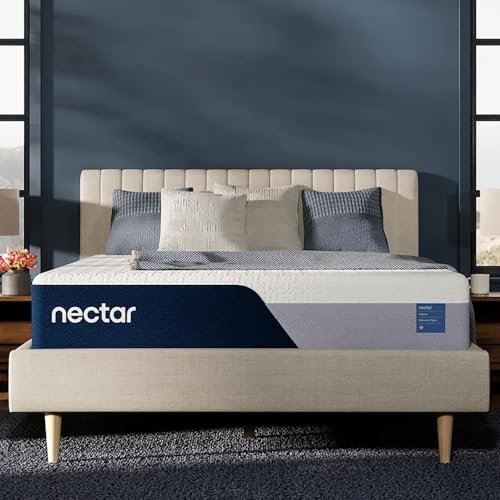
The Nectar Original is a multi-layer foam construction at 12 inches total height: a quilted cooling cover, a gel memory foam comfort layer, an adaptive Hi-Core memory foam support layer, and a high-density base foam, with a transition layer in between. The 12-inch profile matters. Thinner foam mattresses tend to compress through to the base over time, which is how you end up with a sagging trough where you sleep most. The Nectar has enough depth to absorb that wear before it shows up under your hips.
The foams are CertiPUR-US certified, which means they’ve been third-party tested for restricted chemicals (formaldehyde, certain phthalates), heavy metals, and ozone depleters. That’s a meaningful certification with a published standard, not a marketing badge.
This is where the long-term test matters. Two years and change of nightly use later, my mattress looks and feels essentially the same as it did the first week. No visible body impressions, no edge breakdown, no sag in the middle, no pilling on the cover. Memory foam typically shows wear at the 18 to 24 month mark if it’s going to. Mine hasn’t. That matters more than it sounds: at 6 ft 2, 230 pounds, I’m in the heavier-sleeper bracket where foam fatigue tends to show up first. The fact that it hasn’t on my mattress is an honest data point on the build, not a marketing claim.
The 365-night trial is a serious differentiator. Most direct-to-consumer competitors offer 90 to 120 nights, which isn’t long enough to test through a full seasonal cycle. A mattress that feels right in February might sleep too hot in July, and you won’t know until you get there. The lifetime warranty covers manufacturing defects, sagging deeper than 1.5 inches, and cover or zipper failure. Read the fine print before you buy (the warranty is non-transferable and requires you keep proof of purchase, and certain claims require photo evidence and a measured sag depth), but it’s one of the more honest warranties in the category.
Edge support gets flagged as the build’s weak point in a lot of reviews, but two years in (at 230 pounds), I have not had that experience. Sitting on the edge to put on shoes feels stable, no dramatic give. Sleeping near the edge feels the same as sleeping in the middle. Lighter sleepers and couples sharing a Queen may have a different experience, and if you want the firm-perch edge of a hybrid mattress, the Nectar isn’t going to deliver that. But the collapsed-edge framing some reviews lean on hasn’t matched what I’ve actually slept on.
Value for money
At a Queen MSRP of $1,199, a usual sale price around $799, and a checked price of $699 on August 16, 2026, the Nectar Original sits in a tight sub-$1,000 segment with Casper Original, Tuft & Needle Original, and a handful of Amazon-only foam brands. It’s not the absolute cheapest option in that group. It is the one that pairs a 12-inch profile, CertiPUR-US foams, a 365-night trial, and a lifetime warranty. Most competitors give you two of those four; Nectar gives you all four. That combination at this price is unusual, and it’s most of why I’d recommend it over the cheaper options.
Step up to the $1,500-and-above tier and you start getting hybrid coil systems, firmer edge support, and more sophisticated cooling layers: Saatva Classic, DreamCloud Premier, Helix Midnight Luxe. Whether those upgrades are worth roughly twice the money depends on whether your specific complaints are heat, edge support, or bounce. If they aren’t, the Nectar delivers most of what matters at well under half the price, which is the trade I made consciously and don’t regret. If they are, the upgrade is worth taking seriously.
One pricing note: Nectar runs sales constantly. The mattress rarely sits at MSRP for long. If you see it at $799 or below, that’s the real price, not a discount (as of August 16, 2026 it sat at $699, under its own usual sale number). Don’t let a countdown timer or a “50 percent off” banner pressure you into a same-day decision. Financing is available through their site if paying upfront isn’t an option.
See Nectar pricing on Amazon →
Who it’s for
Buy the Nectar if: you sleep mostly on your side or back, you’re upgrading from a worn-out or budget mattress, and you want the safety net of a year-long trial. It’s also a strong pick if you have shoulder, hip, or lower-back pressure points that need contouring, or if you’re a first-time mattress-in-a-box buyer who wants a low-risk way to learn what foam feels like. The price-to-quality ratio is genuinely good in the sub-$1,000 segment, and that’s the bracket I bought into. Two years later, I’d buy it again.
Skip the Nectar if: you run hot at night and can’t manage your bedroom temperature, you sleep on your stomach more than a third of the time, you want firm edge support to get in and out of bed easily, or you prefer the bouncy, responsive feel of a hybrid or innerspring mattress. One honest gripe from my own experience: at 6 ft 2 and 230 pounds, if I were buying again I’d consider stepping up to the Nectar Premier or Hybrid for the extra foam depth. The Original works for me, but a heavier or taller sleeper who wants more cushion would probably be happier on the Premier. Memory foam isn’t the answer for everyone, and that’s fine. Better to know going in than to spend a year second-guessing the purchase.
How it compares
I haven’t slept on every direct competitor for two years, but here’s the honest landscape from research and short-term in-store tries (and one I’ve actually owned).
vs. Casper Original (~$895): Same price tier, similar all-foam approach. The Casper has slightly better edge support and a more zoned feel, firmer under the hips, softer at the shoulders. Trial is 100 nights vs. Nectar’s 365. Close call; pick on trial length and current price.
vs. Saatva Classic (~$1,795): Saatva is a meaningfully more premium mattress, hybrid innerspring-and-foam construction, real edge support, better airflow, and white-glove delivery instead of a box. Worth the money if heat and edge support are your priorities. For most side sleepers, the Nectar covers what matters at less than half the cost.
vs. Purple Original (~$1,399): I owned a Purple before this one, and I’ll be honest: the polymer grid is doing something memory foam can’t. Pressure-relief and active cooling in the same surface, with a feel that’s genuinely unique. I miss it. But at $1,399 (and routinely higher), you’re paying close to double for that difference. The Nectar isn’t matching the Purple feature for feature, but it’s getting me most of the way there at a quarter to a third of the price. If your budget can absorb the Purple, take the trial. If you’re trying to land on a quality mattress without spending $2,000, the Nectar is the strongest middle ground I’ve found.
Final verdict
Two years on the Nectar Original, my take is straightforward: it does the main job (pressure relief, spinal alignment, no early sag at 230 pounds) better than anything else I’d point a sub-$1,000 buyer toward. It’s not the coolest-sleeping mattress on the market for hot-bedroom sleepers, the edges are softer than a hybrid, and stomach sleepers should keep looking. If you have the budget for a Purple or a Saatva and your priorities are heat or bounce, take the upgrade. For side and back sleepers who make up most mattress buyers and don’t want to spend $2,000 to get a mattress that lasts, the Nectar removed a real source of nightly discomfort for me at a price that didn’t require financing.
The 365-night trial is the part that should close the deal for anyone on the fence. You can sleep on it through a full year (through a hot July, through a cold January, through a few weeks of bad sleep that has nothing to do with the mattress), return it for a refund if it doesn’t work for your body, and you’re out shipping costs at most. That’s a fair deal, and it’s rare in this category.
Overall rating: 8.4 / 10. Check price on Amazon →
Cross-shopping the two? We put them side by side in our Nectar vs Casper head-to-head.