Honest reviews, every week. Subscribe →
Better Homes & Gardens

Better Homes & Gardens 8-Cube Organizer Review (2026): The Honest Apartment Storage Buyer’s Guide

7.5 / 10 Editor's rating

A genuinely usable IKEA Kallax dupe at $50–$90, in eight-plus finishes, with the standard particle-board caveats: don't over-tighten cam screws, don't overload the 30-lb-per-cube rating, and don't expect to move it across town once it's together. The right buy for renters, dorms, and kid playrooms; spend up for the Kallax if you have a heavy book or vinyl collection.

$69 $89
Check price on Amazon

Pros

  • Cheap for what you get, $50 to $90 in most finishes
  • Looks better assembled than the price tag suggests; finished on all sides
  • Fits the entire ecosystem of standard 13-inch fabric storage bins
  • Versatile (works vertical or horizontal as bookcase, divider, TV stand, or pantry
  • Eight-plus finishes, including options IKEA doesn't carry

Cons

  • Particle board, not real wood). Shelves can sag under heavy loads over time
  • Cam screws strip easily if you rush assembly with a power driver
  • Does not move well once assembled; back panel is thin paperboard
Best for Renters on a tight budget Dorm rooms and first apartments Kid playrooms and toy storage Fabric-bin pantry organization in apartments without a dedicated pantry Room dividers in studio apartments
Skip if Heavy book collections meant to live on the shelves for years Vinyl record collections over 400 LPs Anyone who wants solid wood furniture Frequent movers who don't want to disassemble between apartments

Some links on this page are affiliate links. If you buy through them, we may earn a commission at no extra cost to you. We only recommend products we’d be comfortable putting in our own apartments.

The Short Version

The Better Homes & Gardens 8-Cube Organizer is the IKEA Kallax dupe that lives at Walmart, and on a budget it’s the right answer more often than it isn’t. You get a 30-pound-per-cube particle-board cube unit in the $50 to $90 range, in eight or nine finishes, that fits standard 13-inch fabric bins and works as a bookshelf, a room divider, a kid’s playroom organizer, a vinyl record holder for casual collections, or a pantry stand-in. It’s not solid wood, it’s not heirloom furniture, and you should not try to move it across town once it’s together. For renters, dorms, and first apartments, that’s a fair deal.

Owners are consistent on what they get for the money: a piece that looks better assembled than the price tag suggests, paired with the usual flat-pack caveats. Particle board can sag under heavy loads, cam locks strip if you crank them, and the back panel is a thin paperboard sheet that holds the unit square but won’t survive being tipped over. Buy it for the right job and it earns its keep. Buy it expecting a Kallax-grade build and you’ll be mildly disappointed.

What It Is, Dimensions, and Finishes

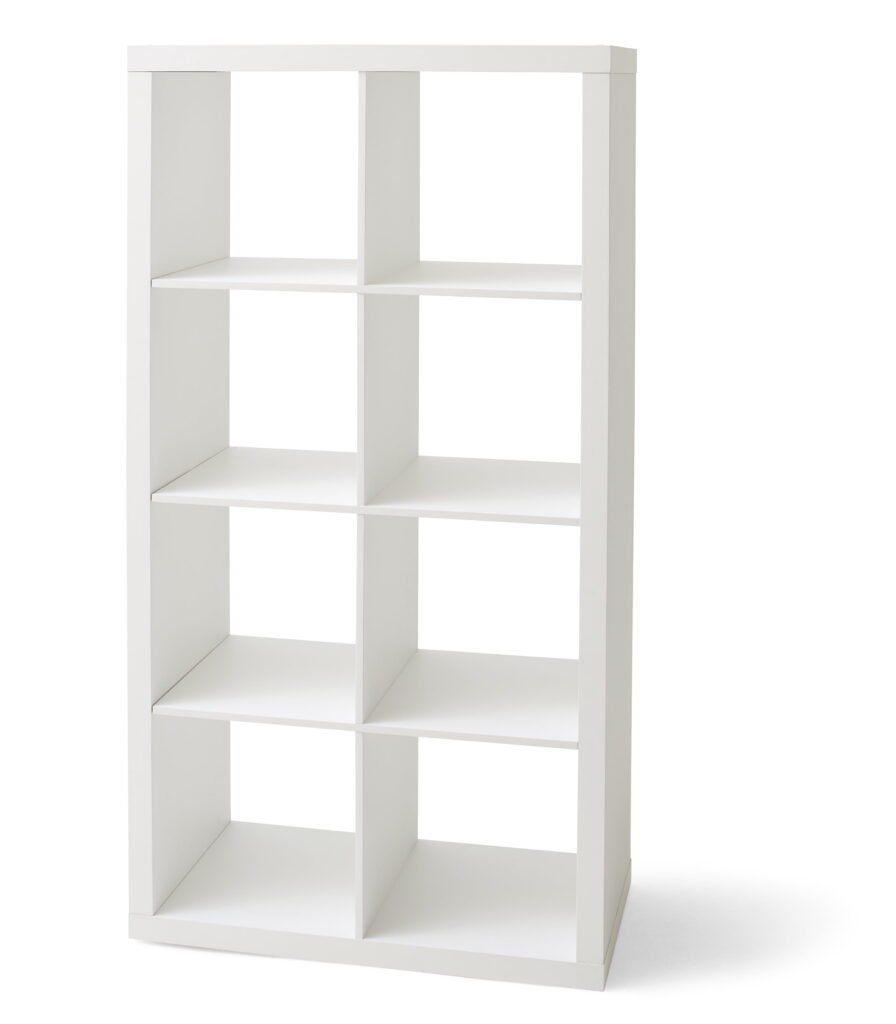
The 8-Cube Organizer is a four-tall, two-wide grid of open cubes built from MDF and particle board with a melamine wood-grain laminate. The standard model measures roughly 30 inches wide, 15 inches deep, and 57 inches tall, and weighs around 55 pounds assembled. Each of the eight compartments is approximately 13 inches by 13 inches by 15 inches deep. Walmart’s spec sheet rates the top panel for 100 pounds vertically and 150 pounds when the unit is laid on its side, with each cube rated for 30 pounds.

Critically, you can stand it up vertically (4 cubes tall, 2 cubes wide) or lay it on its side as a long horizontal credenza (4 wide, 2 tall). Both orientations are explicitly supported. The horizontal layout works well as a TV stand or window-side bench with bins; the vertical works as a narrow bookcase or short room divider in a studio.

Finishes have expanded over the years. As of this writing, Walmart stocks the unit in textured white, solid black, charcoal, rustic gray, acorn, tobacco oak, and a metal-base variant in white, espresso, and rustic gray. The metal-base versions add a few inches of leg lift and a slightly more contemporary silhouette for roughly $20 to $30 more. White and espresso are the most widely cross-listed on Amazon; the more recent finishes (acorn, tobacco oak, charcoal) tend to be Walmart-exclusive.

Assembly, Honestly

This is flat-pack furniture from the same overseas manufacturer (Huisen), which also produces a lot of Walmart’s house-brand storage. Plan on 30 to 60 minutes the first time, less if you’ve put together a Kallax or a similar cube unit before. The hardware is standard cam-lock-and-dowel construction: pre-drilled holes, threaded inserts, and a dozen or so cams that lock the panels together when you turn them a half-rotation. You’ll need a Phillips screwdriver. A small power driver speeds it up but is dangerous on this kind of build. See below.

The single most important rule with budget cube units: do not over-tighten the cam screws. The hardware bites into particle board, not solid wood, and one extra quarter-turn with a power drill will strip the threads or crack the panel from the inside. The instructions tell you to turn the screw 180 degrees from the inserted position; that’s the entire instruction. Hand-driving the last quarter-turn is slower and saves you from a return trip. Owner reviews that complain about “three of four cams broke” almost always trace back to a power driver and an enthusiastic finger.

The back panel is a thin hardboard or paperboard sheet that you tack in place with small nails along the rear edge. It’s the structural square that keeps the unit from racking. It’s also the part most likely to get damaged in shipping, so unbox carefully and inspect before you start. If it arrives creased or punched, that’s the time to call Walmart for a replacement panel. Not after the cubes are together.

One more application note: the included tip-over wall anchor is not optional in homes with kids or pets. A 4-tall vertical cube unit loaded with bins is genuinely top-heavy, and the strap takes 30 seconds to install.

What Owners Consistently Mention

What buyers love. The price-to-look ratio is the headline. Assembled, with bins in the cubes and something on top, it reads as legitimate furniture rather than dorm-room placeholder. Edges are finished on all sides (so the back of the unit doesn’t show raw particle board if you use it as a divider), and the laminate is durable enough to wipe clean. Buyers who use it for fabric-bin storage (pantry overflow, craft supplies, kid toys, linen closet replacement). Overwhelmingly say it does the job for years if they don’t overload it.

The horizontal-or-vertical flexibility comes up constantly in positive reviews. Owners who buy it for one apartment, move, and reconfigure it as a different shape in the next place get genuine value out of that. The 13-inch cube interior fits the entire ecosystem of standard fabric storage cubes, which makes accessorizing it cheap and easy.

What buyers flag. Three patterns recur. First: this is particle board, not real wood. Heavy items (a full cube of hardcover books, a packed vinyl crate, a CRT monitor) will visibly bow the shelves over months. Second: cam screws can strip if you rush. The fix is patience during assembly, not a different product. Third: it does not move well. Once assembled, the back panel is the only thing keeping the unit square, and dragging it across a room or up stairs racks the joinery and loosens cams. If you move often, plan to disassemble it for transit.

A smaller but real complaint: opening sizes are sometimes a hair tighter than the spec implies. Most fabric bins labeled 13x13x13 fit fine, but some snug models (especially seagrass or rigid plastic bins at exactly 13.0 inches) bind on the way in. Walmart’s own house-brand 12.75-inch bins are sized to fit, and most fabric bins are forgiving enough to compress slightly. If you’re buying expensive baskets, measure twice.

BH&G 8-Cube vs. IKEA Kallax 4×2: The Real Comparison

This is the dilemma every shopper hits, so I’ll be direct.

The IKEA Kallax 4×2 is the original. It’s slightly more substantial in the hand, the panels feel a touch denser, the joinery is tighter, and IKEA’s quality control is more consistent unit-to-unit. Pricing currently runs about $30 to $50 above the BH&G equivalent depending on finish and IKEA’s seasonal stock. Cube interiors are within a fraction of an inch of each other, both rate cubes at roughly 30 pounds, and both ship as flat-pack particle-board kits with cam locks. The Kallax wins on long-term sturdiness in customer reviews, Apartment Therapy’s roundup pegs Kallax at roughly 79 percent five-star versus the BH&G’s high-60s.

The honest call: if you live within easy reach of an IKEA and you’ll keep the unit for more than two years, the Kallax is worth the extra $30 to $50. If you don’t have an IKEA nearby, you’re shopping on a tight budget, you want a finish IKEA doesn’t carry (acorn, tobacco oak, the metal-base variants), or this is a starter piece for a first apartment, the BH&G is the smarter buy. Both are particle board. Neither is heirloom furniture. The Kallax is just a slightly better version of the same idea.

Worth noting: Sauder’s Cubic series and ClosetMaid’s 8-Cube unit sit in the same price band as the BH&G with similar tradeoffs. Sauder edges out on overall fit and finish; ClosetMaid runs a touch cheaper but feels lighter. None of them meaningfully outperform the BH&G on the metric most shoppers actually care about: a square, finished cube unit that holds bins for a few years and doesn’t cost a paycheck. Check price on Amazon →

Best Use Cases

Studio room divider. Stood vertically, the 57-inch height blocks sightlines without cutting off airflow or natural light, and the open cubes let you face bins one direction and decor the other. The finished back panel matters here. You don’t get raw particle board staring at one side of the room.

Kid playroom storage. Eight cubes, each sized for a fabric bin labeled by category (blocks, art supplies, dress-up, books), is the standard Montessori-adjacent setup for a reason. Wall-anchor it. Skip the heaviest toy bins on the top row.

Vinyl record holder for casual collections. Each 13-inch-deep cube fits roughly 65 to 80 LPs depending on sleeve thickness. Eight cubes is enough for around 500 to 600 records, fine for a casual collection. Heavy collectors should not use this. A full cube of records weighs 35 to 45 pounds, which is over the 30-pound rating; the shelves will bow over time. If you have more than 400 records and intend to keep collecting, step up to a Kallax or a real wood unit.

Fabric-bin pantry. Apartments without a dedicated pantry use this constantly: a horizontal layout in a kitchen corner, top surface as a coffee station or microwave stand, eight cubes loaded with labeled bins for grains, snacks, and bulk items. The melamine wipes down for spills.

Entryway shoe and bag storage. Horizontal, low to the ground, with bins for hats and gloves on one row and exposed cubes for shoes on the other. Fits in narrow entryways where a true console table doesn’t.

Cube Bin Sizing, The One Tip That Saves a Return

Most fabric storage cubes sold for cube-unit organizers are nominally 13 inches by 13 inches by 13 inches. They’re designed for exactly this kind of unit, Kallax, BH&G, ClosetMaid, Sauder, and they fit. The honest caveat: rigid bins (plastic, seagrass, water-hyacinth) measured at exactly 13.0 inches sometimes catch on the cube opening, which can be a hair under-spec. Soft fabric bins compress and slide in. If you want zero friction, look for bins labeled 12.75 inches or labeled “fits Better Homes & Gardens organizer”. Walmart’s house brand makes a matched set.

The cube interior is 15 inches deep, which is deeper than a standard 13-inch bin. You’ll have a couple of inches of space behind each bin, useful for stashing a power strip or hiding cables along a TV setup, but worth knowing if you were planning to store anything that needs to sit flush.

Who It’s For, Who Should Skip

Buy it if: you’re a renter or first-apartment shopper on a tight budget, you want a flexible storage piece you can reconfigure as bookcase, divider, TV stand, or pantry, you don’t have an IKEA nearby, you need a specific finish IKEA doesn’t carry, or you’re buying for a kid’s room or playroom where you’ll outgrow the piece in a few years anyway.

Skip it if: you have a vinyl collection over 400 records, a heavy book collection that will live on the shelves for years, you want solid wood that you’ll keep through several moves, or you move frequently and don’t want to disassemble the unit every time. Anyone in those camps should look at a real-wood bookcase from a brand like Crate & Barrel’s CB2 line, a used solid-wood unit from Facebook Marketplace, or (if the budget stretches) go for the Kallax.

Where to Buy and Price Context

Walmart is the primary channel. Better Homes & Gardens is Walmart’s exclusive house brand. Pricing typically lands between $50 and $90 depending on finish, with white and gray usually the cheapest and the metal-base variants at the top of that range. In-store pickup at Walmart is usually $10 to $20 cheaper than the same unit shipped because the box is large and heavy enough to push freight surcharges into the price. If you have a Walmart within driving distance, that’s the move.

Amazon carries the white and espresso finishes (and intermittently rustic gray) through resale and third-party sellers. Amazon pricing tends to run $10 to $30 higher than Walmart on the same finish, and shipping reliability varies by seller. The upside is Prime delivery and Amazon’s return process, which is more forgiving than Walmart’s freight returns if a panel arrives damaged. For shoppers without a nearby Walmart, Amazon is the next-best channel.

Final Verdict

The Better Homes & Gardens 8-Cube Organizer is the right piece for the right job. It’s not pretending to be solid wood, and shoppers who go in clear-eyed about that get a flexible, finish-rich, $50-to-$90 storage workhorse that fits standard bins, looks better than its price implies, and reconfigures between vertical and horizontal layouts as your space changes. Take your time on assembly, hand-finish the cam screws, anchor it to the wall, and don’t load a cube past its 30-pound rating, and it’ll quietly handle apartment storage for years.

Skip it if your real need is a vinyl-collector shelf, a long-haul bookshelf, or a piece that survives multiple moves intact. Spend up for the Kallax or a real-wood unit instead. For everyone else (and that’s most renters and first-apartment shoppers). This is a defensible buy.

Overall rating: 7.5 / 10. Check price on Amazon →

Last researched: May 2026. Pricing and finish availability shift seasonally; verify the finish and dimensions on the retailer’s listing before you order, and check Walmart in-store pickup for the best price.