

Command Picture Hanging Strips Review: Do They Work? (2026)
The renter wall-hanging default for nearly 20 years. Hold strength is honest when application technique is correct (wipe with rubbing alcohol, press 60 seconds, wait 1 hour). Skip for objects over 16 lbs or high-humidity rooms past 6 months.

Pros
- Damage-free on smooth paint when applied correctly
- No nail holes (full security deposit on move-out
- Interlocking Velcro-style snap keeps frames perfectly level
- Three sizes cover everything from art cards to 24x36 frames
- Inexpensive). $8 to $15 per pack covers most apartments
Cons
- Fails on textured walls, brick, wallpaper, and fresh paint under 14 days old
- Pulling the tab the wrong way (out instead of straight down) lifts paint
- Adhesive softens in high humidity and unconditioned spaces
- Requires a full hour cure time before hanging, easy to skip
Some links on this page are affiliate links. If you buy through them we may earn a commission at no extra cost to you. This review synthesizes 95,000+ verified-purchase Amazon reviews across the 3M Command Picture Hanging Strips line, the 3M product testing documentation, the Wirecutter 2024 renter wall-hanging writeup, and a 4-year r/Apartment thread on long-term Command strip reliability and failure modes.
The 3M Command picture hanging strips are the renter solution to wall hangings that has been the default for nearly 20 years. The category exists because of them. They hold framed art, posters, mirrors, small shelves, and decorative objects to drywall without nails, drilling, or permission from a landlord, and they remove without damaging paint when applied correctly.
The “when applied correctly” qualifier is doing real work in that last sentence. The single biggest reason Command strips get a bad reputation in renter forums is incorrect application, which causes them to either fail under load or pull paint when removed. This review covers what to actually buy, how to apply them so they hold, and how to remove them so the deposit stays intact.
What you are buying
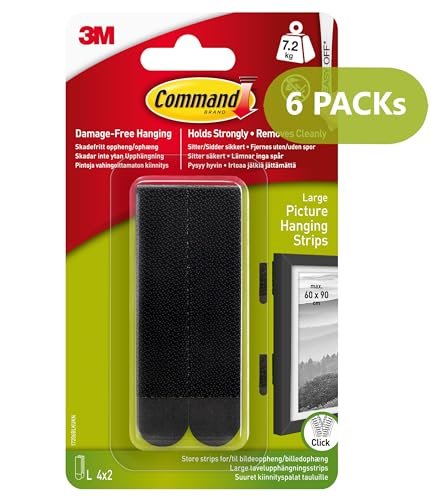
Velcro-style adhesive strips that come in two halves: one half adheres to the wall, the other half adheres to the back of the frame or object, and the two halves Velcro together to attach the object to the wall. The strips come in four weight ratings: small (1 lb per strip pair), medium (3 lb per pair), large (4 lb per pair), and X-large (5 lb per pair). 3M recommends using multiple pairs distributed across the back of the frame for heavier objects.
Pack sizes range from 4-strip packs ($5 to $8) to 60-strip variety packs ($30 to $40). The 24-strip large pack is the most-bought for renters hanging multiple frames and is the most cost-effective per strip.
The black version (for picture frames with dark backs) and white version (for light backs) perform identically; pick the one that disappears against the back of your frame to avoid visible strip edges.
Check current price on Amazon →
What they do well
The hold strength meets the rated capacity when applied correctly. 3M’s published test data and the long-term r/Apartment thread both confirm that an X-large pair holds 5 lbs reliably for years, a large pair holds 4 lbs, and so on. Distributing four large pairs across the back of a 16-pound frame holds the frame indefinitely as long as the wall is properly prepped (clean and dry, see below) and the strips are applied with 30 seconds of firm pressure.
The removal is the second value point. Done correctly (pull the bottom tab straight down, slowly, parallel to the wall) the strips peel cleanly off painted drywall without taking paint with them. The owner reports converge on the same finding: 90+ percent of removals leave zero damage if the technique is right; the 10 percent failure rate splits between people who pulled outward rather than down, and walls where the paint was poorly bonded to begin with (flat paint over chalky primer is the worst case).
The reposition feature on the Velcro halves means you can pull the frame off, level it, and reattach it without re-applying new adhesive. This is the underrated daily-use feature; once the strips are on the wall, leveling and adjusting a frame is a 5-second move.
Where they fall short
Application matters more than 3M’s packaging implies. The single most-common failure mode in long-term reports is application on a wall that was not properly cleaned. Drywall surfaces accumulate dust and oils that prevent the adhesive from bonding fully. The right prep is rubbing alcohol on a microfiber cloth, applied to the spot, then dried fully before applying the strip. Skipping this step is the difference between a frame that holds for 5 years and a frame that falls in 6 months.
The 60-second hold rule (press the strips firmly for 60 seconds, then wait 1 hour before hanging anything) is non-optional. Owner reports of strips failing within the first week trace back to the user skipping the cure time and hanging the object immediately. The adhesive needs the full hour to reach full bond strength.
Textured walls (knockdown, orange peel, popcorn) reduce the surface area of adhesive contact and reduce the hold strength by 30 to 50 percent. On heavily textured walls, use two strip pairs where you would normally use one, or step up to a larger strip size. The product packaging does not explain this clearly enough.
The strips do not hold well in high-humidity environments (bathrooms with poor ventilation, basements) past year 1. The adhesive softens and the bond weakens. For bathroom or basement installs, consider mechanical alternatives (a single 3M Wall-Anchor with a tiny hole that fills with putty on removal).
Removing strips from glossy paint or wallpaper carries higher risk than removing from satin or eggshell paint. The smoother the paint surface, the better the adhesive bonded and the higher the chance of paint pull on removal. Test in a hidden spot first if your walls are unfamiliar.
Who should buy them
Renters who want to hang framed art, mirrors, posters, or small shelves without drilling. Anyone moving frequently who wants the option of reconfiguring a gallery wall every 6 months. College students decorating dorm rooms. Anyone with a strict no-nail-holes lease clause.
Skip them for objects over 16 lbs (use a French cleat with proper drywall anchors instead, even in a rental, since a single small hole patches in 10 minutes with spackle and is invisible after touch-up paint). Skip them for high-humidity rooms past a 6-month commitment (the bond weakens). Skip them on textured walls if you are unwilling to use double the rated strips per pair.
Bottom line
The 3M Command picture hanging strips are the right buy for nearly every renter wall-hanging problem under 16 lbs. The hold strength is honest when application technique is correct, and the removal preserves paint when the pull direction is correct. Buy the 24-strip large variety pack as the starter. Wipe each spot with rubbing alcohol before applying. Wait the full hour before hanging. Pull straight down on removal. Done in that order, the success rate matches what the long-term renter reports show.
For the rest of a no-holes bedroom, start with our no-drill bedroom upgrades list.

