Some links on this page are affiliate links. If you buy through them we may earn a commission at no extra cost to you. The Command half of this comparison draws on our own review of the strips and the 3M testing documentation and four-year r/Apartment reliability thread behind it; the Monkey Hook half draws on OOK/Hillman’s product documentation and the owner reviews on Home Depot and Walmart for the OOK value packs. Prices are read from the live Amazon listings on the date shown next to each one.
Start with how each one fails, because that is the whole decision. A Command strip fails in one of two ways: the frame is on the floor at 3 a.m. because the wall was dusty or the paint was fresh, or the strip comes off on move-out day with a strip of paint attached because somebody pulled the tab outward instead of straight down. Both failures cost you a patch-and-paint line on the deposit statement. A Monkey Hook fails in exactly one way: you hit a stud, plaster, or brick and it will not go in. When it does go in, it holds 35 pounds on ordinary half-inch drywall, and what it leaves behind is a pinhole you close with a fingertip of spackle.
So the question is not which product is better. Under about 16 pounds on smooth, cured paint, adhesive is the cleaner answer and leaves nothing at all. Above that, or on any wall with texture, the steel hook is the honest answer, and the pinhole it leaves is smaller than the damage a failed strip does. Most renters should own both. Here is how each one actually holds, then the table, then the verdict by weight class.
How Each One Actually Holds
Adhesive: the strip is only as strong as the paint
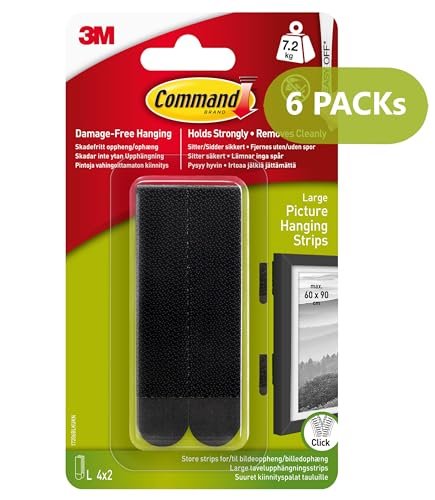
Command Picture Hanging Strips are two halves of a Velcro-style closure with foam adhesive on the backs: one half on the wall, one on the frame, and the two click together. The rated hold per pair runs from 1 pound (small) to 4 pounds (large) and 5 pounds (X-large), and 3M’s guidance is to spread pairs across the back of the frame, which is how four large pairs carry a 16-pound frame. Our Command strips review goes through the application in detail; the short version is that the adhesive bonds to the paint, not to the drywall, so everything depends on what the paint is doing.
Three things the packaging undersells, all from the long-term owner reports our review synthesized. The wall has to be wiped with rubbing alcohol and dried, because drywall paint collects a film of dust and skin oil that stops the foam from bonding. The strip has to be pressed hard for at least 30 seconds (we recommend a full minute) and then left alone for an hour before anything hangs on it, which is the step people skip and the reason strips fall in week one. And paint that is less than about two weeks old, textured walls (knockdown, orange peel), wallpaper, and humid rooms all cut the hold, texture by 30 to 50 percent. A strip that failed for any of those reasons has usually taken paint with it, which is the deposit problem.
Steel: the hook borrows the drywall’s own thickness
A Monkey Hook is a single piece of zinc-plated spring steel bent into a long curve with a point on one end and a hook on the other. You push the point into the drywall and twist; the curve follows the inside of the panel, so the hook ends up bearing on the back of the drywall, not on the paint. OOK (the Hillman brand that makes it) rates it at 35 pounds on half-inch residential drywall and 50 pounds on five-eighths commercial board, with no tools, no anchor, no stud, and the same guide says the entry hole is small enough to patch with a dab of filler. Owner reviews on Home Depot and Walmart for the value packs repeat the same two notes: the hole is barely visible, and the hook is useless if it meets a stud, plaster, brick, or tile, because it needs hollow space behind the panel to curl into.
What it cannot do is float a frame flush and level the way strips do; the frame hangs from its wire or sawtooth on a hook that sits proud of the wall by a few millimeters, so heavy frames tilt forward slightly at the top unless you add a bumper at the bottom corners. And we will say plainly that we have never load-tested a Monkey Hook to its rating; 35 pounds is the maker’s number, and nothing in the owner reports we read disputes it.
Side by Side
| Command Picture Hanging Strips (Large) | OOK Monkey Hook | |
|---|---|---|
| Price (Amazon) | $12.73 (checked October 6, 2026) | $3.98 for the 4-pack (checked October 6, 2026); $17.99 for the 30-piece Monkey plus Gorilla Hook kit (October 6, 2026) |
| Rated hold | 4 pounds per large pair; four pairs for a 16-pound frame (3M) | 35 pounds on 1/2-inch drywall, 50 pounds on 5/8-inch (OOK); the Gorilla Hook in the kit is the 50-pound version |
| Surfaces | Smooth, cured painted drywall; not texture, wallpaper, brick, or fresh paint | Hollow drywall only; not studs, plaster, brick, tile, or concrete |
| Install | Wipe with alcohol, press 30 to 60 seconds, wait one hour | Push and twist, hang immediately, no tools |
| What it leaves | Nothing, if removed correctly; a paint pull if not | A pinhole, every time |
| Removal | Stretch the tab straight down, slowly | Twist back out |
| Reusable | No; the adhesive is single-use | Yes, unless bent |
| Leveling | Frame sits flush and can be pulled off, leveled, and re-clicked | Frame hangs from its wire; level by sliding on the hook, bumper at the bottom corners |
| Fails when | Dusty or fresh or textured paint, humidity, skipped cure time, wrong pull direction | You hit a stud or the wall is not drywall |
The Deposit Math
Renters treat “no holes” as the goal, and for anything under a few pounds it is. But a pinhole and a paint pull are not the same category of damage. A Monkey Hook hole is smaller than a finishing nail’s and closes with lightweight spackle and a swipe of a putty knife; most landlords would not find it, and the ones who do are looking at a thirty-second fix. A failed strip that lifted a patch of paint means feathering the edge, priming, and matching a paint color you do not have, and that is the line item that shows up on a deposit statement.
Read your lease before you decide. “No nails” clauses are common; “no wall damage of any kind” clauses are less common and are the only ones that make a pinhole a problem. If you are unsure which you have, test either product on a spot the couch will hide: a strip for the paint-pull question, a hook for the is-this-even-drywall question. One test in a hidden spot answers more than a thousand words of instructions.
By Weight Class
Under 5 pounds, which covers prints, photo frames up to about 11 by 14, and light mirrors: strips, on smooth cured paint, one medium or large pair per corner. This is the case the strips were built for, and it is the one where they leave a wall that looks like nobody ever hung anything. If the wall is textured, go to the hook even here; strips on orange peel are a coin flip.
Five to 16 pounds, which is most framed art and gallery-wall pieces: strips still work, but the margin gets thin and the prep gets non-negotiable. Four large pairs for a 16-pound frame, alcohol wipe, full minute of pressure, hour of cure. If you will not do all of that, or the frame has a wire and no flat back for the strips to grip, a single Monkey Hook carries the whole thing with margin to spare and you are done in ten seconds.
Sixteen to 35 pounds, which is a real mirror, a large canvas, or a small shelf: Monkey Hook, no debate. Our review draws the strip line at 16 pounds for a reason; above it the adhesive is stacking pairs against physics and the failure is expensive. Over 35 pounds, neither. Use a French cleat on proper drywall anchors, or find the stud, even in a rental; two small screw holes patch in ten minutes and are invisible after touch-up paint, which is cheaper than a mirror on the floor.
Check the Command Large strips on Amazon →Read our review
Check the Monkey Hook 4-pack on Amazon →
What We Would Not Do With Either
Bathrooms and other humid rooms with strips past a few months; the adhesive softens and the owner reports on that are consistent. Paint that went on in the last two weeks, with either, because a hook’s pinhole through soft paint chips a wider crater than it should and a strip will pull it off in a sheet. Wallpaper with strips, ever. Ceilings with either. And nothing above a bed on strips alone, whatever the rating says, because the cost of the one-in-ten failure is not a broken frame.
One more: do not use a Monkey Hook to hang a shelf that will hold weight that changes. The rating is for a static hanging load on a wire; a shelf loads the hook in a direction it was not bent for. For no-drill shelving and storage, our no-drill storage picks and the renter’s storage guide cover the tension-pole and freestanding options that carry weight without asking the wall to.
Where We Land
Buy the strips for the light stuff on good paint, and follow the prep, because the prep is the product. Buy the 30-piece Monkey and Gorilla Hook kit once and keep it in the junk drawer; it covers every mirror, heavy frame, and textured wall you will meet for the length of the lease, at $17.99 when we read it, and the pinholes it leaves are the cheapest damage a rental wall can take. If you only buy one, buy the hooks; a pinhole is a smaller problem than a frame on the floor.
Check the Monkey and Gorilla Hook kit on Amazon →
For the rest of the renter wall, the no-drill bedroom upgrades list covers lighting and headboards that hang the same way, and our small bedroom layout guide is where to start if the wall you are decorating is the one behind the bed.
What to consider
Weight and surface decide it, not brand. Adhesive bonds to the paint, so dust, fresh paint, texture, and humidity are its enemies and its failure pulls paint. The hook bears on the back of the drywall, so it needs hollow drywall and always leaves a pinhole. Read the lease for a no-damage clause versus a no-nails clause, and test either product in a spot the furniture hides.
Frequently asked questions
Do Monkey Hooks damage walls?
They leave a pinhole where the point entered, smaller than a finishing nail hole. Owner reviews for the OOK value packs describe it as barely visible, and it closes with a fingertip of lightweight spackle. They do not work in studs, plaster, brick, or tile, because the curved steel needs hollow drywall to curl into.
How much weight can Command strips hold?
Per 3M, 1 pound per small pair, 3 per medium, 4 per large, 5 per X-large, spread across the back of the frame. Four large pairs carry a 16-pound frame on smooth, cured paint that was wiped with rubbing alcohol, pressed for at least 30 seconds, and left for an hour before hanging. Textured walls cut that by 30 to 50 percent.
Which is better for a heavy mirror in an apartment?
A Monkey Hook, or the 50-pound Gorilla Hook from the same kit, up to its rating on drywall. Above 35 pounds, use a French cleat on proper anchors or find a stud; two screw holes patch in ten minutes and are cheaper than a broken mirror.
Can you reuse Command strips or Monkey Hooks?
Monkey Hooks twist out and go back in as long as the steel is not bent. Command strips are single-use; the adhesive does not re-bond once the tab has been stretched, though the Velcro halves can be unclicked and re-clicked to level a frame while the strips stay on the wall.
Will a pinhole cost me my security deposit?
Usually not. Most leases prohibit nails or require walls returned to their original condition; a spackled pinhole meets both in practice. A lease that bans wall damage of any kind is the exception, and in that apartment strips on good paint are the only zero-mark option under about 16 pounds.