Some links on this page are affiliate links. If you buy through them we may earn a commission at no extra cost to you. This guide is built from 18 months of r/SmallApartments and r/onebagcooking threads, the Wirecutter 2024 small-kitchen tools roundup, the Apartment Therapy 2024 rental kitchen guide, and the actual lived experience of furnishing four apartments in five years.
The standard advice for building a kitchen is wrong for renters. It assumes you have space, you will stay long enough to invest, and you will pick a specialty (baker, grill master, weekend project cook) you can build the kitchen around. None of those assumptions hold in a 600 square foot apartment with 24 inches of counter and a 14-month lease.
This guide is the actually-honest version: what to buy first, what to wait on, what to never buy for a rental kitchen, and how to think about the build order when your budget is finite and your counter is more finite. It applies whether you are a renter setting up a first apartment, a small-space dweller downsizing from a house, or anyone whose kitchen is fundamentally constrained by square footage rather than skill.
The single rule that organizes everything else
Counter space is the binding constraint, not budget. Every tool committed to permanently has to earn a 12 to 18 inch slot. Every tool stored in a cabinet has to be retrieved each time it is used, which means it has to be used often enough that the retrieval friction is worth it.
This rule is what kills the standard kitchen-build advice. The standard advice tells you to buy a coffee maker, a toaster, a microwave, a stand mixer, a knife block, a 5-piece pot set, an Instant Pot, an air fryer, a blender, and a food processor. Each of those is a small countertop appliance that takes 12 to 18 inches of permanent counter space, and most apartment kitchens cannot fit more than two without becoming unworkable.
The right question is not “what do I want?” The right question is “of all the things I want, which two earn the counter?”
What to buy first (a $400 starter kit)
The order matters. We are deliberately building for immediate function before optimization.
Step 1: One chef’s knife and one cutting board (~$190)
The single most-used kitchen tool is a knife. A good chef’s knife replaces 80% of the function of a knife block. Buy the Wüsthof Classic 8-inch ($170 on Amazon, $90 on sale at Sur La Table 2 to 3 times per year) or the Victorinox Fibrox 8-inch ($45, the legitimate budget alternative used by professional kitchens as the line-cook default).
Pair it with one good cutting board. The OXO Good Grips Carving Board with juice groove ($20) is the right default for an apartment kitchen because the juice groove catches meat juices and the non-slip feet keep the board stable on small counters. Skip the wooden boards for now; they need maintenance that rarely happens in a rental kitchen.
Step 2: One cast iron skillet (~$24)
One Lodge 10.25-inch cast iron skillet does eggs, steaks, sears, vegetables, pancakes, and corn bread. It lives on the stovetop, which means zero storage cost. It lasts effectively forever. Modern Lodge pans ship pre-seasoned; the old “you have to be careful with cast iron” advice is mostly a myth.
Practical care guidance: cook with it, wipe out after use with a paper towel, occasional rinse with mild dish soap if needed (this is the modern guidance, the no-soap-ever advice is wrong), oil it lightly before storing. That is it.
A non-stick pan can be added later if you make a lot of eggs and want easier cleanup, but the cast iron does eggs fine once seasoned properly. The Lodge is your first pan. The All-Clad stainless and the carbon steel French skillet come later, if at all.
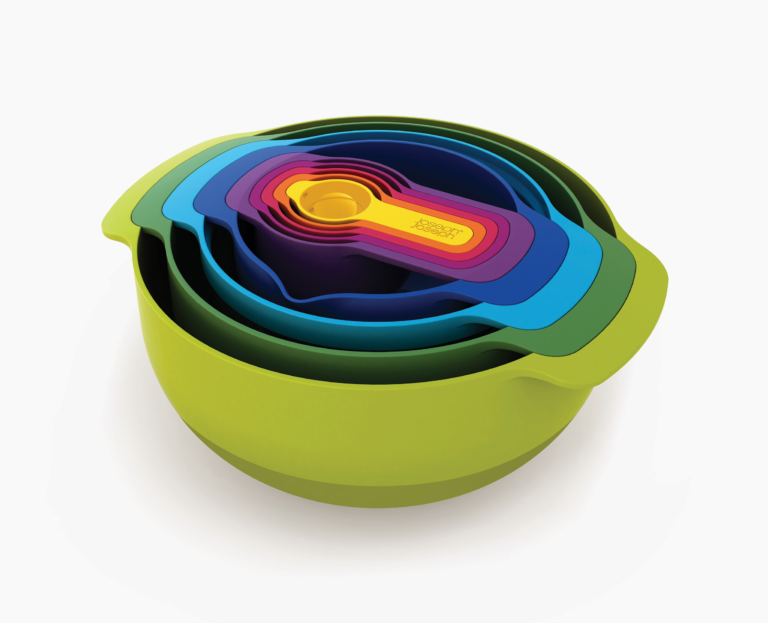
Step 3: A nesting prep set (~$45)
The Joseph Joseph Nest 9 Plus is the right pick for small kitchens specifically because nine prep tools (mixing bowls, sieve, colander, measuring jug, measuring cups) collapse into a single 9.4-inch footprint. The polypropylene construction means it is not oven-safe, but oven-safe mixing bowls are not what apartment cooks lack; mixing bowls that fit in the cabinet are.
The alternative is a 3-piece stainless steel mixing bowl set ($30) plus a colander ($15) plus measuring cups ($15) plus a measuring jug ($20). That totals $80 for tools that do not nest, take three cabinet shelves, and have to be retrieved separately. The Nest 9 is the correct apartment-kitchen choice.
Step 4: A glass storage system (~$31)
The Pyrex Simply Store 7-piece set in three sizes (1, 2, 4, 7-cup) covers every leftover and meal-prep container need a small household has. Glass over plastic for anything that touches reheated food: it does not stain, does not absorb odors, does not leach plasticizers, stacks reliably in the fridge.
The lids are the wear point on Pyrex; the glass itself lasts decades. When a lid cracks (typical at year 3 to 5), replacement lids are sold separately on the Pyrex website for $5 to $8.
Step 5: One insulated water bottle (~$25)
The Hydro Flask 32oz Wide Mouth (or any equivalent insulated bottle) removes the need for a permanent water glass on the counter. In a small apartment kitchen, every item not on the counter is a win. This category includes anything that lives in a daily-use rotation but does not need to live in the kitchen at all: the water bottle, the coffee tumbler, the reusable shopping bags.
Total: ~$315 for a functional starter kitchen. The remaining $85 of a $400 budget goes to the optional picks below, in priority order.
What to add next (in priority order)
A coffee solution (Hario V60, ~$35)
If you currently drink drip coffee from a counter-eating coffee maker, the Hario V60 pour-over is the right upgrade. It sits on top of any mug or carafe, takes no counter space when not in use, and produces meaningfully better coffee than a $40 drip machine. A kettle is required (you probably already have one) and paper filters are $5 for 100.
If you currently use a Keurig, the V60 is also a meaningful upgrade in coffee quality but a meaningful downgrade in convenience. Be honest with yourself about which trade-off you actually want.
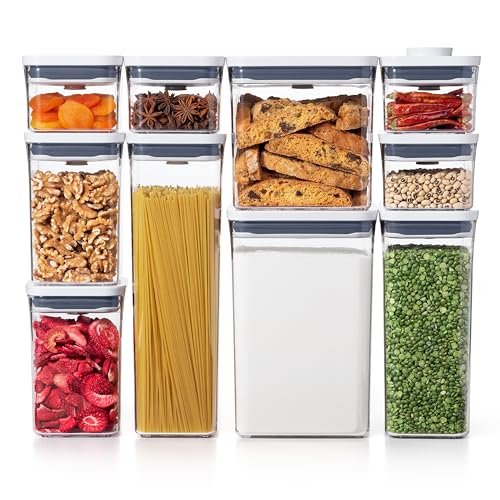
The OXO POP container system (~$150 for the 10-piece)
The OXO Good Grips POP containers are the long-term pantry system. Airtight push-button seal keeps dry goods fresh past their bag’s shelf life (flour past 12 months, coffee near-fresh longer). Stackable square footprints save 30% of shelf space versus cylinders.
This is the second-largest kitchen investment after the knife and is worth it specifically for renters who plan to stay 18 months or more. For shorter leases, the cheaper Vtopmart equivalents at $50 for a 7-piece work fine for first-year function.
A second pan (carbon steel French skillet, ~$60)
Once cast iron is the workhorse, a carbon steel skillet is the second pan. Carbon steel heats faster than cast iron, weighs less, and develops a similar non-stick patina with use. The Matfer Bourgeat 11-inch carbon steel skillet ($60) is the chef’s-choice default.
Buy the second pan only if you find yourself wanting two pans going at once weekly. For most apartment cooks, one cast iron handles everything.
Yamazaki Tower kitchen storage accessories (~$20 to $50 each)
The Yamazaki Tower line solves rental-kitchen storage in the same way the brand solves the rest of the apartment: powder-coated steel, modular, no-drill. Their magnetic spice rack adheres to the fridge side ($25), their over-cabinet wine glass holder works without modifying anything ($30), their under-shelf basket adds storage to wasted vertical space ($20). Buy one at a time as you identify a specific problem; do not buy the whole catalog at once.
What to never buy for a rental kitchen
A knife block set
Knife blocks take 8 to 10 inches of permanent counter space to store 5 to 9 knives, of which most cooks use 2. The bread knife and paring knife that are genuinely useful can live in a drawer or on a magnetic strip. Skip the block, buy individual knives for $15 to $30 each as specific use cases emerge.
A stand mixer (unless you bake regularly)
KitchenAid stand mixers are $300, take 18 inches of counter, and weigh enough that they will not be moved. They are correct for households that bake weekly. For everyone else, a $20 hand mixer in a drawer covers 95% of the use case (whipped cream, frosting, the occasional cake batter).
A countertop espresso machine
Genuine espresso requires a real grinder ($200+) plus a real machine ($300+) plus counter space (18 inches minimum). For most apartment coffee drinkers, the Hario V60 plus a hand grinder ($30) produces better coffee than a $300 home espresso machine. The espresso upgrade is correct only if you specifically want espresso drinks and will commit to the workflow.
An Instant Pot (probably)
The Instant Pot is loved by a vocal minority and forgotten by the majority. Owner surveys consistently show that average usage drops below monthly by year 2. If you have a specific use case (rice without a rice cooker, weekly beans, bone broth), buy it. Otherwise it lives in a cabinet and never comes out.
A 5-piece pot and pan set
Sets are how cookware brands sell you four pieces you do not want to get the one you do. Buy a 10-inch cast iron, an 8-inch non-stick (if you make a lot of eggs), a 3-quart saucepan ($30), and a 6-quart Dutch oven ($60 for a Lodge enameled version) as separate purchases as each need emerges. That gives you the same functional coverage as a $250 set for half the cost and zero pieces that take cabinet space unnecessarily.
How to think about the timeline
If you have just signed a 12-month lease and you are setting up the kitchen, the right pace is: buy the $315 starter kit on day one, add the OXO POP system at month one (after you have figured out what dry goods you actually keep), add the Hario V60 at month two or three (if your coffee habit justifies it), and consider Yamazaki Tower storage accessories as specific storage problems emerge.
If you are in month six of a lease and trying to fix a kitchen that does not work, the right diagnostic question is: which two countertop items am I never using? Move them to a cabinet or a closet. The empty counter space is what fixes the kitchen, not adding more tools.
If you are about to move and trying to decide what to take, the right test is: have you used this in the last 90 days? If no, donate or sell it. Apartment-kitchen tools are designed to be light and modular precisely because most renters move every 18 to 36 months and dragging a stand mixer across town is rarely worth it.
Frequently asked questions
Do I really need cast iron? It seems intimidating. The intimidation is overrated. Modern Lodge pans ship seasoned and ready to use. The maintenance is wipe-out-with-paper-towel after each use plus an occasional rinse if you cook something sticky. The advice that you can never use soap is wrong; mild soap is fine on modern seasoned cast iron. The advice that constant re-seasoning is required is also wrong; cooking with oil seasons it as you go.
What about non-stick? Isn’t that easier? Non-stick is easier short-term and worse long-term. PFOA-free non-stick coatings degrade after 2 to 4 years of use even with careful handling, at which point you replace the pan. Cast iron lasts forever. Buy a cheap 8-inch non-stick for eggs if you find cast-iron eggs annoying, but make the cast iron your primary pan.
Why no microwave on the list? Most apartments come with a microwave already installed. If yours does not, a microwave is the one countertop appliance that earns its space in most kitchens because reheating leftovers is a daily-multiple-times use case. A basic 0.7 cubic foot countertop microwave is $80 and takes about 18 inches of counter.
What about a toaster? Toaster oven over toaster, every time. A toaster does one thing; a toaster oven toasts plus reheats plus bakes small things, which means it can replace the oven for many quick uses (frozen pizzas, reheating slices, broiling toast). The Breville Smart Oven Air Fryer ($300) is the chef’s-pick countertop combination; the Black+Decker 4-slice toaster oven ($40) is the budget version that covers 80% of the function.
How do I store all this without a pantry? Vertical space. Over-the-door pantry organizers ($25), under-shelf hanging baskets ($20), and the cabinet door interior (Command hooks or magnetic spice racks) all add storage without modifying the kitchen. If you have less than 6 linear feet of pantry shelving, the Yamazaki Tower line’s modular storage is the right place to spend $100 to $150.
Where to start
For most readers, the right first move is the 7 Best Kitchen Tools for a 600 sq ft Apartment listicle, which is the same starter kit explained product-by-product. For specific products covered in depth, our individual reviews of the Joseph Joseph Nest 9 Plus, the OXO POP container line, and the Hydro Flask 32oz Wide Mouth walk through what each product does well and where each falls short.
Frequently asked questions
Do I really need cast iron? It seems intimidating.
The intimidation is overrated. Modern Lodge pans ship seasoned and ready to use. Maintenance is wipe-out-with-paper-towel after each use plus an occasional rinse with mild dish soap (the no-soap rule is a myth). Cooking with oil seasons it as you go. After two weeks of regular use, it becomes the easiest pan in the kitchen.
Why not non-stick? Isn't that easier?
Non-stick is easier short-term and worse long-term. PFOA-free non-stick coatings degrade after 2 to 4 years even with careful handling, at which point the pan needs replacement. Cast iron lasts forever. Buy a cheap 8-inch non-stick for eggs if cast-iron eggs frustrate you, but make the cast iron your primary pan.
Why no microwave on the list?
Most apartments come with a microwave installed already. If yours does not, a basic 0.7 cubic foot countertop microwave at $80 earns its 18 inches of counter because reheating leftovers is a daily-multiple-times use case.
What about a toaster?
Toaster oven over toaster, every time. A toaster does one thing; a toaster oven toasts plus reheats plus bakes small things. The Breville Smart Oven Air Fryer ($300) is the chef's pick; the Black+Decker 4-slice ($40) is the budget version that covers 80% of the function.
How do I store all this without a pantry?
Use vertical space. Over-the-door pantry organizers ($25), under-shelf hanging baskets ($20), and cabinet door interiors (Command hooks, magnetic spice racks) all add storage without modifying the kitchen. The Yamazaki Tower line's modular storage is the right place to spend $100 to $150 if you have under 6 linear feet of pantry shelving.
I currently have all the things you tell me not to buy. What now?
Diagnostic question: which two countertop items have you not used in the last 90 days? Move them to a cabinet, a closet, or out of the apartment entirely. The empty counter space is what fixes the kitchen, not adding more tools.
What if I'm about to move?
Test each item: have I used this in the last 90 days? If no, donate or sell. Apartment-kitchen tools are designed to be light and modular precisely because most renters move every 18 to 36 months. Dragging a stand mixer across town is rarely worth it; replacing it on the other end if you actually want it again is cheaper and easier.